
When facing severe limb trauma, advanced infection, or chronic complications, patients and their care teams are confronted with a profound decision: whether to pursue limb salvage or amputation. This choice is rarely straightforward. It demands a highly individualized approach, considering a spectrum of medical, psychological, functional, and personal factors.
This blog post offers a balanced overview to help guide conversations with your physician or surgical team, drawing on clinical insights and research. Please remember, this information is for general guidance only and should not replace professional medical advice.
Understanding the Options: A Quick Comparison
To begin, let's define the two paths:
- Limb Salvage: This involves a surgical effort to preserve and reconstruct the injured limb.
- Amputation: This is the surgical removal of the limb segment, typically followed by prosthetic fitting and rehabilitation.
Here's a side-by-side look at some key differences:
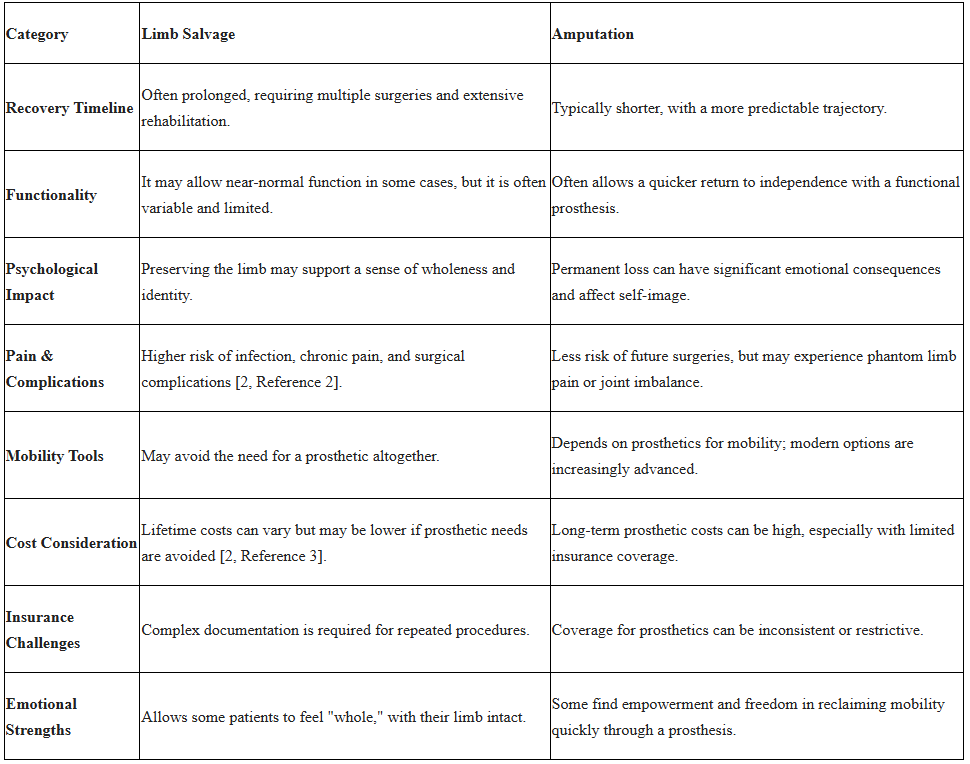
The decision-making process is deeply personal and medically nuanced. As highlighted by a 2020 Lancet review, patient values, such as lifestyle, career, access to rehabilitation, and support systems, play as much of a role as clinical indicators [3, Reference 1].
Holistic Considerations for Patients and Their Support Systems
To help guide your conversations with medical professionals, consider these 9 key questions:
- What is my current quality of life with the injured limb? This helps assess the baseline and potential for improvement.
- Am I prepared for multiple surgeries and a potentially long recovery? Limb salvage often entails a prolonged and demanding recovery period.
- Do I have help at home? And can I navigate my home after amputation? Your home environment and support system are crucial for recovery, regardless of the path chosen.
- Do I have access to a high-quality prosthetic and rehabilitation center? For amputation, access to excellent post-operative care and fitting is paramount for regaining independence.
- What are my mobility goals? Understanding your desired level of activity and independence can heavily influence the choice.
- How do I emotionally feel about limb loss versus ongoing procedures? This delves into the psychological and emotional impact, which can be significant for either choice.
- Have I received a second opinion from both a reconstructive surgeon and a surgeon who collaborates with a high-quality prosthetic company? A multidisciplinary approach and diverse perspectives are vital for an informed decision.
- What kind of Insurance Benefits do I have, and is DME (Durable Medical Equipment/Prosthetics) covered and up to what point? Financial considerations, especially concerning long-term prosthetic costs and insurance coverage, are a critical part of the planning.
- In the end, what are my priorities for my health, and which option best supports those priorities? Ultimately, the decision must align with your personal goals and medical reality.
Making an Informed Choice
Choosing between limb salvage and amputation is a significant journey. Both paths offer the potential for recovery, independence, and an improved quality of life, granted through different methods. The best decision is an informed one, made collaboratively with a multidisciplinary care team and deeply centered around the patient’s personal goals, values, and medical reality.
If you are facing this decision, we encourage you to consult your physician or surgical team to discuss your individual situation and treatment options. Consider making an appointment with one of our providers. Consider listening to this podcast to be inspired by patients and providers. Here at Alliance Prosthetics and Orthotics, we believe patient satisfaction is a non-negotiable, that all people can achieve goals, and people and their time are valuable.

